If our birthday is the reason for the trip, gorillas are the inspiration and ultimate end game. We’ve been desperate to see gorillas in the wild forever! Finally, we can say that we have done it!
In Uganda, the gorillas mostly live in Bwindi Impenetrable Forest. It’s a tiny little park at only 331 km², but what it lacks in size, it makes up for in excitement! It’s home to the world’s largest population of Mountain Gorillas, with over 600 gorillas.
Bwindi was not declared a national park until 1991. The gorillas were nearly extinct due to the bush meat trade. No, people don’t eat gorillas, they eat antelope. Gorillas just get caught in the crossfire. They can get caught in snares or killed by antelope hunters when they get in the way. So, in 1991 the government kicked all of the Batwa People (Pygmies) and made them live in the village. Now the gorilla numbers are steadily increasing. I can’t remember how many gorilla families there are, but most of them have been habituated.
Habituated. What a fancy word. What does that mean? It means that they are used to people and don’t care if you stand around and take their picture. How do they get habituated? People go and find them. The gorillas get angry and chase them away. The people very smartly run away. Then, the next day, they go find the gorillas again. The gorillas get angry and chase them away. The process is repeated every day until the gorillas stop chasing them away. I think it takes about 2 years to fully habituate them. If we were brave souls, we could have participated in gorilla habituation and spent 4 hours chasing gorillas. Needless to say, we are not that brave, fearless, or athletic!
There are strict rules for visiting the gorillas. You go in groups of 8 people plus the guide, guard, and porters. Obviously, there are a limited number of groups that go each day. Each group goes to a different gorilla family. There is no doubling up and all ending up with the same group of gorillas. The chaos that happened with the chimpanzees doesn’t happen with the gorillas.
We were assigned to track the Kutu family, which means ear in the local language. Supposedly, one of them had a unique looking ear. Hence, the ear family. How do we track gorillas? Well, there’s a group of trackers that goes out in the morning and actually tracks them (based on where they left them the day before). The guide takes you in the general direction and waits to hear from the trackers. This is not as easy as it sounds because, as one might expect, there is horrible cell phone reception in the forest. At one point, we stopped for about 15-20 minutes trying to find signal. They don’t want us to walk in the wrong direction and have to walk back or to scale a mountain unnecessarily. As it was, we were walking on very narrow trails on the side of the mountain with very steep ledges. Most of our hike was on fairly level ground through the forest. There were a few tricky spots and minimal climbing. Although, I was super glad for my porter.
Let’s pause and discuss porters. Anyone who goes gorilla trekking and does not hire a porter is an absolute idiot. And that’s a fact, not an opinion. They carry your backpack for you (My camera is heavy! Not to mention the weight of two bottles of water.) That way, your backpack doesn’t get in the way while you are climbing or traversing a treacherous part of the trail. But the best part is they grab your hand and help you through slippery and tricky parts of the hike. The minimum charge is $20 and more if you are able. Being a porter is a coveted position, and they only get to do it a couple days a month because there are so many people that want to do it. (Now would be a good time to pause and Google the average salary in Uganda. Go ahead. I’ll wait.) Obviously, we paid Blessing and Alexander more than $20. We are a lot of work! Even if you don’t think you need a porter, you should hire one. Even if you don’t have a bag, you should hire a porter, but you should have a bag to carry your water in. What’s another $20 after what you spent to go Gorilla Trekking? Seriously. Support the local economy! Positively impact the community! Help save a gorilla by showing there is more money in tourism than poaching. Don’t be cheap now! Just hire a porter!
Where was I? Oh, we were with a family of 6 from Isreal that looked like they just woke up and said lets go see some gorillas. They didn’t have gloves, so they had to rent them for $5 each. I got mine on sale at the end of the season at Menards for only $7. (Pause to sing–Save big money at Menards…). The parents each hired a porter, but wouldn’t let them hold their hands. The mom had knee surgery 4 months ago and needs the exercise to get better? (like can’t you do that tomorrow? Let him help you!)
It’s hard to say how long we walked to get to the gorillas because we stopped several times. The first time, Sylvia (the guide) sent Joeffrey (the guard) ahead as tribute. We had passed some elephant poop, so I thought she was sacrificing him to the elephants. She claimed she sent him to determine which fork in the road we should take to avoid unnecessary backtracking, but I know better. And we also stopped for about 20 minutes searching for the aforementioned cell signal. It was about an hour and a half after we started that we met up with the trackers.
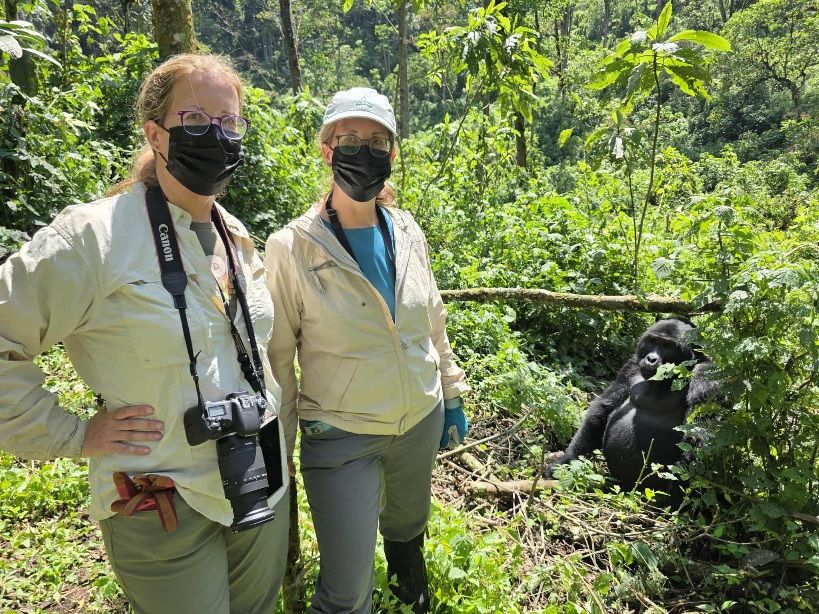
So, you quickly dig out your camera, drink some water, put on your face mask, and leave your walking stick with the porter. The porters aren’t allowed to go around the gorillas in order to minimize human contact. Then you turn the corner and enjoy the most amazing hour of your life. We were told to keep 20 meters away from the gorillas, but thetwinsontour don’t know the metric system, and apparently, neither do the guide or tracker. They had us within about 5-6 feet of the gorillas. They were everywhere! The Kutu family has 13 members.
One of them even ran up and hit me in the arm before turning around and running back under his shade tree. Unfortunately, there is no video of my near demise, so you will just have to take my word for it. He also hit my sister a few minutes later, but again, there is no videographic evidence. It was the greatest moment of my life!
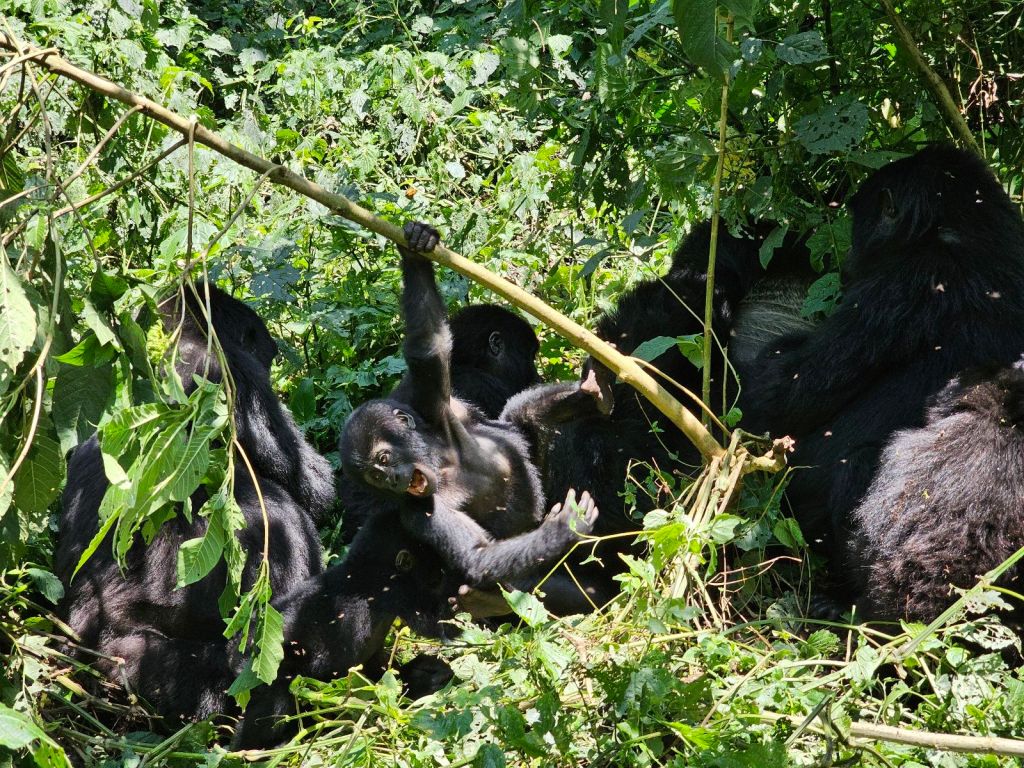
It’s difficult to get out of their way because we were standing on a bit of incline surrounded by vegetation. Luckily, we did not have to move too much after that. We found them at nap time, rather than feeding time. That means that they are all laying around together instead of moving around looking for their favorite snacks. This makes for AMAZING pictures! We took so many! This should not be a surprise to any of our faithful readers.
The gorillas laid around so we could behold their magnificence while the babies climbed trees and did cute baby gorilla things. Oh, and the Silverback farted. A lot. Gorillas do not like the sun, so they kept seeking shadier areas to rest in, but at a slow and leisurely pace.
Unfortunately, an hour with gorillas is over even faster than my lunch break at work. All too soon, we were bidding adieu to our furry friends and heading back to the porters and our bags. You are not allowed to drink water in front of gorillas or eat in front of them either. They don’t want the gorillas to decide they like fruit snacks or granola bars and become aggressive like those videos of little monkeys that steal your cell phones in Indonesia. You also can not use a walking stick in front of them because they will see that stick as a sign of aggression. Really, you can’t hold onto a walking stick while taking photos anyway.
Then it was time to trek back to civilization. Miraculously, the trip back was about half as long as the walk in. After clutching the porter’s hand over the tricky, slippery spots, we arrived at a small clearing to eat our snacks and drink more water. Which was about 10 minutes until the end of the hike. We didn’t even have to walk all the way back to the visitor center because there was a road where our guides were waiting to drive us back. All in all, I think I got less than 3k steps in, so little over a mile round trip. This was actually a moderate hike because we are professionals. And parts were slightly grueling. But overall, most of it was pretty level. I think it was called moderate because of the starting point. We had to cross a little creek bed at the beginning, which makes you think it’s going to be an impossible trek and makes you question your life choices.
Our clothes got much dirtier doing the chimpanzee trekking than the gorilla trekking because we were not in as thick of vegetation, we walked in a single file line, and we were mostly able to stick to the paths. Our guide, Sylvia, did have a machete to chop at vegetation if it was in the way. And when you get back to the lodge, they take your boots and gaiters off of you. Don’t try to take them off yourself, or they will look at you with sad eyes like Artichoke does when you don’t share your cheese with her. They put some crocs on your feet, and they clean your boots so that they look brand new. Such great service! (And that way, you don’t track mud all over your room.)


I am sure that I have missed a million important things, but that’s all I have for now.
Love,
thetwinsontour
PS. Oh, oh, oh, I almost forgot. Hot water bottles! They put hot water bottles in our bed each night because its cooler here in the mountains. Such a simple, old-fashioned comfort. I love this part of African safaris! When I noticed that lump under the blankets, it was so hard not to immediately jump into bed and snuggle that hot water bottle with my feet.
 thetwinsontour